
 Every now and then you get little wins like this. They’re more than a fluke. They’re less than design. They’re a sign that things are falling into place.
This novel is going to be a supernatural creepy: something between a traditional ghost story and a Charles Williams spiritual thriller. Ninety percent of what goes on will be everyday, but around everything there will be a shadow of something more, culminating in a final is-it-or-isn’t-it scene (and it probably will be).
We’re now about a quarter to a third of the way in (first draft). Our heroine’s boyfriend has been abducted and the preoccupying question at the moment is whether he is dead. We’re about to learn that he is. The scenes running up to the reveal are moody and premonitory. A filthy cloud hangs over London. Supporting characters discuss the Last Days. The dregs of a glass of red wine look grey by candlelight. We are walking the border between life and death.
Now, the action. Heroine is on the run. Bad guys control the city and are hunting her. She’s gone to the Kensal Green area to look for friends who will shelter her, but they aren’t there. She faces a night on the street.
I’ve known this scene would be coming, because she has to be brought to a state where she will make a fateful choice. I had intended to set it in the rubble of a ruined building (London has had some serious back-story in this novel). I was just thinking about the practicalities of heroine, who has many qualities but is NOT a street-kid, finding this vaguely-imagined place of shelter, when, fingers hovering over the keys, the thought struck.
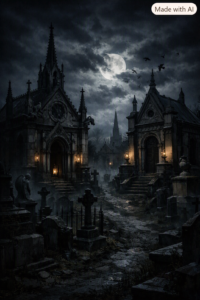
We’re in Kensal Green. Of course! She spends the night in the cemetery! It’s huge, gothic, it fits perfectly. We can work in as much spooky, gloomy, frontier-of-life-and-death stuff as we like. Or as we think we can without making it all look horribly contrived.
Now the thing is, I had written those words ‘Kensal Green’ about twenty-four hours before I thought of sending her into the cemetery itself. The action takes place in North London, and I’ve been dropping in place-names more or less at random as I go. Why had I sent her there at this moment? Put another way, if I had written ‘Kentish Town’ the day before, I almost certainly wouldn’t have thought of sending her into the cemetery. I’d have ploughed on with Plan A and missed the opportunity. Was this just a fluke, or did I already know subconsciously what needed to be done?
I’m going to say it’s more than just a fluke. Story-tellers will know what I mean about this: you feel as you work that the story wants to get itself told in a certain way. There’s a feedback loop between you and this living thing you are working on. And when it starts to happen, in little ways like this, you sense it. Something is falling into place.
Last Updated on September 14, 2026 by John