
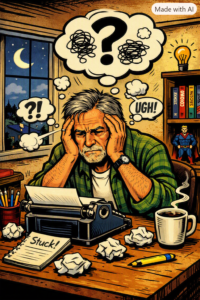
 How much time do we spend thinking about what we are going to write, rather than actually writing it?
This is one of those very simple questions that is very nearly impossible to answer. For one thing, thinking and writing happen simultaneously. You can’t separate the two. For another, have you ever tried putting a timer on your thinking? Click the stopwatch, think about something, don’t think about anything else, and then, when you have finished your thought, click the stopwatch again. As if thoughts could be nice, contained and measurable like a solid brick. They aren’t.
But let’s attempt an answer. I type at about 45 words per minute (say). In a normal two-and-a-half hour morning (excluding permitted coffee breaks) I expect to put about 1500 first-draft words on the page. In theory, I should be able to write 45 words x 60 minutes x 2.5 hours = 6,750 words.
So this suggests that I am spending 1500/6750 x 100% = say 22% of my time writing and the rest of it staring at the screen or pacing up and down. (My wife will testify that I pace A LOT). That’s nearly four times as much time thinking as writing. Assuming that I really am thinking about writing rather than about yesterday’s catastrophic bowls match.
But-but-but… It’s not as simple as that. Not nearly, Because what this doesn’t capture is all the time I’ve spent thinking about the book before I switched on the computer and hit the first page with my working title. The germs of the thing I’m working on now first wormed their way into my head some four decades ago. I have three or four pages of notes I tapped out some time in 2020. I have a couple of books on my shelves that I had put on my Christmas list the previous year, for research. I have another from last Christmas, too. How do I count all that?
And we’re talking here about ‘Thinking’ as if were a specific, well-defined activity. It isn’t. There’s thinking and thinking. And also thinking. Sometimes (rarely) I will think in concentrated, period-defined fashion, stomping off on a walk while I worry out the plot-line, or lying awake piecing together an upcoming paragraph because I’ve nothing better to do. Much more often I am going around vaguely conscious that I have this novel on the go, and suddenly I think “Oh, I can do this with that scene.” It’s like a huge cloud drifting over the landscapes of the mind. You can’t touch clouds, and it’s almost impossible to measure them. But every now and then they produce thunderbolts.
Neither thoughts nor thunderbolts take much time to happen, of course.
Finally, I’ve been talking so far only about what we might call “first draft” thinking: all the stuff that goes into getting the story out of the recesses of the mind and down in some form that can be read. But there’s a whole further stage, which is editing. That first draft can be read, but would anyone actually want to read it? No. So we’ve got to change the words we’ve written for some better ones. I will normally do a second, third and fourth draft, changing less each time. Is this writing, or is it thinking? It’s both. Perhaps the proportion of writing to thinking is actually higher now. The thinking is easier, because you can see what you are working on. Perhaps.
We could have a go at this from the other end, too. It’s 40 years since I started writing. I’ve produced about 15 novels and a few short stories, not all published. Let’s say that’s 1.5 million words (some of those novels were quite long). In 40 years there’s only 21 million minutes. Some of that is spent in deep or light sleep, so let’s estimate that we have 17 million minutes of possible thinking time, allowing the dreams that may come to us in REM sleep as potentially useful thoughts – because just occasionally, they are. 17m x 45 words per minute pm (assuming a constant typing speed over the last forty years) = a maximum possible output of 765 million words. 1.5m/765m = er… about .002%. If I had spent every possible hour of day and night in the last forty years thinking and dreaming about writing, I still could not have managed more than 99.998% of my life on Think. .
So the answer seems to be somewhere between 5 and 500 times as much thinking as writing, very likely at the lower end of that range.
I think.
Last Updated on August 24, 2026 by John